


Nacalai USA, Inc., a wholly-owned subsidiary of Nacalai Tesque, Inc., Kyoto Japan., was founded in January 2005 in San Diego, California to bridge between the United States and Japan in the scientific research community. Nacalai USA strives to bring the most innovative and stringently quality-controlled biochemicals and research tools from Japan into the United States market, and also to introduce United States technologies and products into the Japanese research market.
Nacalai USA provides the highest quality research products necessary for the Life Science research such as Molecular Biology and Proteomics. Most of the products are manufactured and packaged in the high level of manufacturing facilities in Japan.
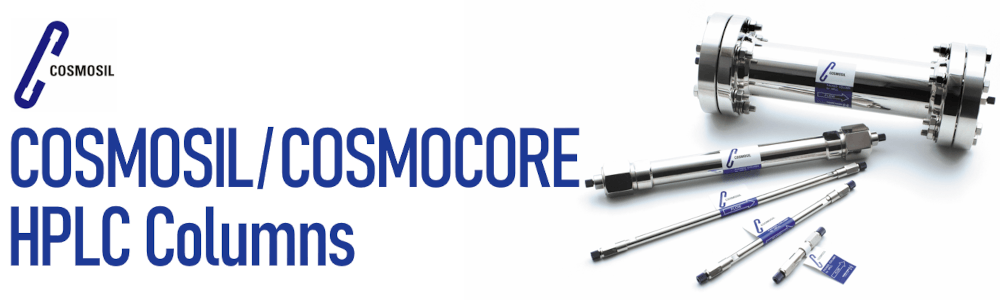
Nacalai USA also provides Cosmosil brand HPLC columns. The Cosmosil chromatography product line includes several robust reversed phase and prep columns as well as specialty columns such as the Cholester (cholesteryl group), NPE (nitrophenylethyl group), PYE (pyrenylethyl group) and Sugar-D. Cosmosil Buckyprep (pyrenylpropyl group) and PBB (pentabromobenzyl group) columns are well recognized worldwide for Fullerene separation.
COSMOSIL 5C18-MS-II is a monomeric type of C18 phase.
COSMOSIL 5C18-AR-II is a polymeric type of C18 phase.
COSMOSIL 5C18-PAQ is designed to offer superior retention of polar compounds and excellent reproducibility in highly aqueous mobile phases, even in 100% aqueous.
COSMOSIL Buckyprep is a pyrenylpropyl group bonded silica based column specifically designed for fullerene separation. The unparalleled separation capabilities have enabled COSMOSIL Buckyprep to become the world benchmark of HPLC column for fullerene separation. COSMOSIL Buckyprep retains fullerenes very strongly with a mobile phase of 100% toluene and exceeds the injection volume of a standard C18 column by a factor of 35. Therefore, preparative-scale separation can be obtained with a 250 mm x 4.6 mm I.D. analytical column.
COSMOSIL Buckyprep-M is a phenothiazinyl group bonded silica based column specifically designed for metallo-fullerene separation. Metallo-fullerenes are retained more strongly than other fullerenes on this column. COSMOSIL Buckyprep-M is also effective for the separation of higher fullerenes and fullerene derivatives.
COSMOSIL PBB is a pentabromobenzyl group bonded silica based column useful for preparative-scale separation of fullerenes. It can be used with carbon disulfide or 1,2,4-trichlorobenzene, which has greater solubility for fullerenes than toluene. The loading capacity of COSMOSIL PBB for C60 and C70 can be three times greater than COSMOSIL Buckyprep
COSMOSIL PYE (pyrenylethyl group bonded) and COSMOSIL NPE (nitrophenylethyl group bonded) column show unique retention characteristics based on multiple separation modes such as hydrophobic, charge transfer and π-π interactions. These columns are recommended for the separation of structural isomers.
COSMOSIL Cholester is a new silica based RP column which employs a cholestery bonded phase. Cholester provides enhanced selectivity over traditional C18 materials and greater performance in separating isomers or other closely related compounds. Cholester is ideal for method development and serves as an excellent alternative to traditional C18 columns.
Conventionally Aminopropyl bounded stationary phases are used for liquid chromatographic analysis of mono- and oligosaccharides. General shortcomings of the conventional Aminopropyl bounded phases are tailing and adsorption of certain saccharides and general low durability (short active life) of these columns. These problems are addressed and solved by the novel COSMOSIL Sugar-D, resulting in better (sharper) separation and much improved durability. In addition COSMOSIL Sugar-D is useful in the separation of highly hydrophilic compounds which are not retained in conventional octadecyl (ODS) bounded stationary phases.
Open column chromatography is an excellent and easy technique for large scale preparation and purification at low cost. Reversed phase C18 packing materials are used but restricted to about 30-50% water in the mobile phase. The COSMOSIL C18-OPN is a new "Water-Wet" C18 packing material developed for Reversed Phase Open Column Chromatography. The C18-OPN material can be used in 100% aqueous eluents.
COSMOSIL HILIC is a new column for hydrophilic interaction chromatography with Triazole bonded silica packing material. The hydrophilic interaction chromatography is a variation of normal phase chromatography where a polar stationary phase is used with a mobile phase which contains a high concentration of organic solvent and a low concentration of aqueous eluent. The main retention mechanism is the partitioning of the polar analytes between the polar stationary and the non-polar mobile phase. As it is also called "aqueous normal phase", the elution order is similar to that of normal phase and the sample elution is in the order of increasing hydrophilicity. Without using ion-pair reagent COSMOSIL HILIC retains highly polar analytes that would not be retained in reversed phase chromatography. It also shows a weak anion-exchange mechanism with the positively charged stationary phase, thus acidic compound is strongly retained.
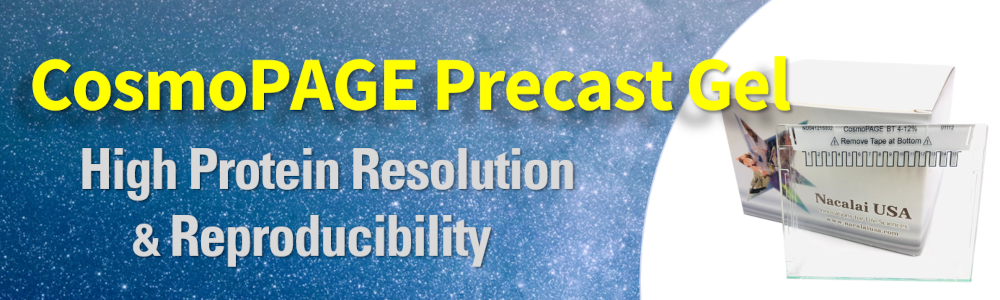
The CosmoPAGE pre-cast gel is ideal for protein electrophoresis. The unique formulation of polyacrylamide provides the best resolution, most strength, best transfer efficiency, and longest shelf life. CosmoPAGE pre-cast gels are available in two product lines: SDS Gel and Native Gel. Each product line has gels available in 1-well, 12-well and 17-well formats for high-throughput protein electrophoresis. CosmoPAGE SDS Gel is also available for 2D electrophoresis. CosmoPAGEM Native Gel is suitable for nucleic acid electrophoresis as well.
Gel-Negative Stain Kit can stain proteins in SDS-PAGE in 20 minutes. The sensitivity is similar to silver staining. Since Gel-Negative Stain binds to the gel but not the proteins, the proteins are not altered and, therefore, better for downstream application.
The Sil-Best Stain One provides maximal silver staining sensitivity with minimal protein modification for optimal mass spectrometry results. The mass spectrometry problems associated with traditional silver stains are eliminated with the Sil-Best Stain One because the reagents used do not modify protein side chains and do not interfere with trypsin digestion. In 80 minutes, 0.4 ng of protein can be detected with low background.
Blocking is indispensable in immunoassays in order to inhibit non-specific binding reactions. Blocking One contains both high molecular weight compounds and bovine serum protein. The result is superior compared to conventional blocking solutions. The preservative does not affect the enzyme activity of peroxidase (POD) or alkaline phosphatase (ALP). Only simple refrigerator storage is necessary, even after opening the bottle.
WB Stripping Solution removes conjugated antibodies from blots, enabling subsequent detections with different antibodis on the very same blot. After the first antigen-antibody reaction and following chemiluminescent visualization, the antibody can be removed by the WB Stripping Solution. A second antigen-antibody reaction can be conducted on the same blot. The same blot can be probed 2-5 times if chemiluminescent detection is employed. Alternatively, one blot can be used multiple times under different conditions to optimise the result of antigen-antibody reaction.
Inhibition of intra and extra cellular proteases is vital to purify and collect the expressed proteins. Saving trouble of finding adequate inhibitors, a wide range of proteases are inhibited by the Protease Inhibitor Cocktail. This product does not interfere with metalloproteins since it is EDTA free.
Phosphatase Inhibitor Cocktail is a mixture of several inhibitors to protect valuable proteins from dephosphorylation. The product preserves phosphorylated proteins existing in small quantity in cells and tissues